

DATA4CIRC completes its first project stage, advancing towards a fully integrated circular manufacturing framework
The DATA4CIRC project has reached a significant turning point. After an intensive first stage of development, the consortium, coordinated by IDENER.AI, has successfully concluded this phase with a formal review meeting that brought together partners to assess progress, validate results, and set the course for what comes next.
At its core, DATA4CIRC is building a data-sharing framework designed to solve one of the circular economy’s biggest bottlenecks: manufacturers lack access to reliable material-origin data, supply chains cannot exchange information without compromising trade secrets, and there are no common standards for tracking products across their full lifecycle. The project’s answer is the DATA4CIRC Solution, a collaborative digital platform built around four interconnected technical components. The first is a system of Federated Data Spaces, secure, privacy-preserving platforms that allow companies to share only the information they choose, using blockchain technology to protect competitive IP while enabling circular collaboration. The second is a suite of Digital Models, including Digital Twins and Digital Threads that create virtual representations of circular value chains and products, enabling real-time simulation and prediction of environmental impact. The third is a Digital Product Passport (DPP) that tracks the full lifecycle of a product, implemented through the Asset Administration Shell standard in line with upcoming EU regulation. The fourth is an AI-assisted End-to-End Lifecycle Assessment tool that uses machine learning to track circular value chains and predict environmental outcomes.
Three real-world use cases are validating this technology across different sectors: agricultural plastics recovery in Spain (with partners CETEC and Green World Compounding), electronic waste recovery in Greece and catalytic converter refurbishment in collaboration with Fiat. All technical developments have progressed on track and have been validated through live demonstrations, confirming the robustness of the solutions being built and their alignment with the real needs of industrial stakeholders.
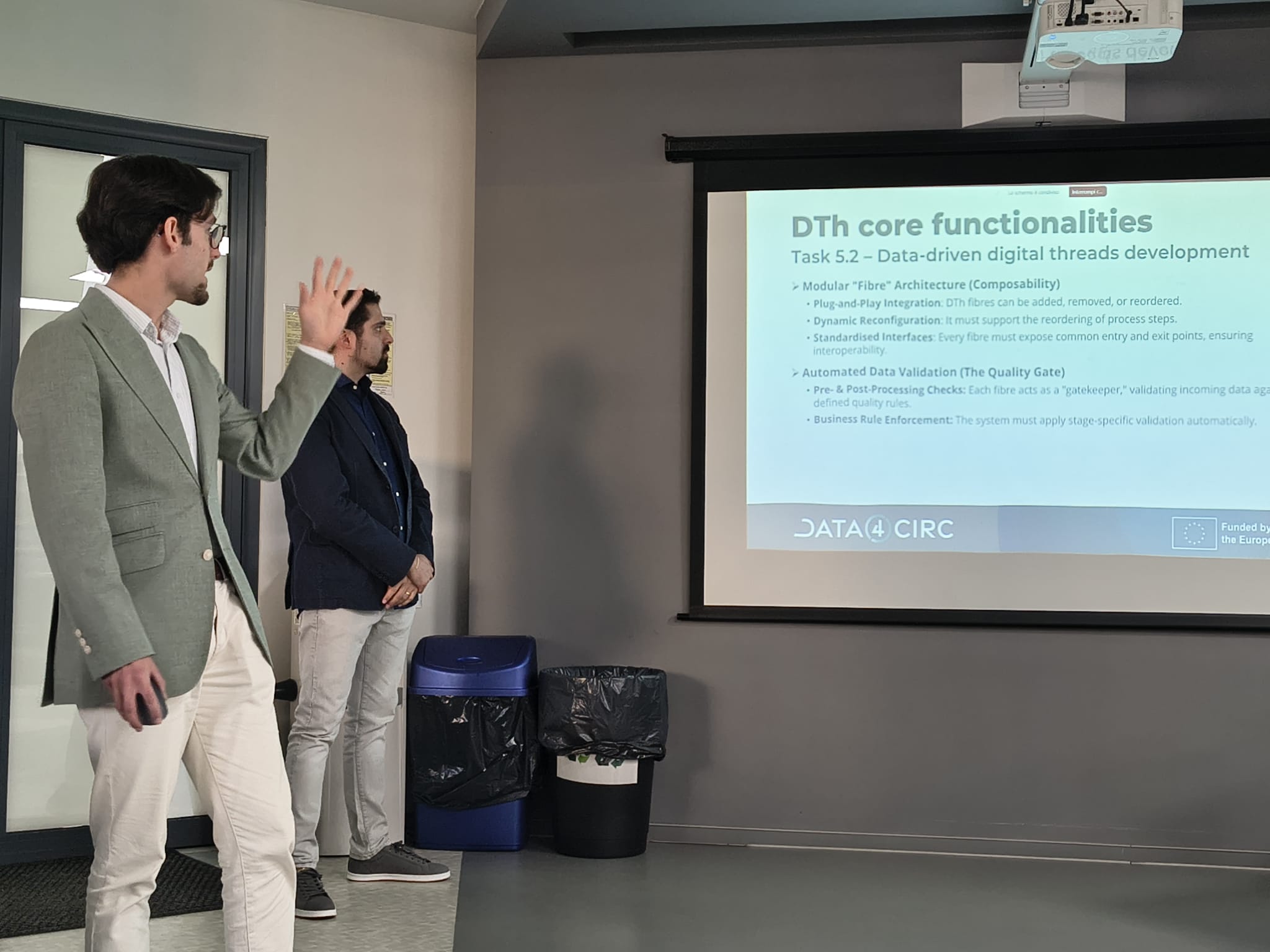
As coordinator, IDENER.AI has played a central role in driving this first stage forward, not only overseeing the overall project direction but also ensuring that the technical components developed by the consortium are converging towards a coherent, integrated whole. At the May 2026 general assembly, the consortium demonstrated two working prototypes of the DS4CIRC Data Space Portal, delivered the first live demonstrations of Digital Twins and Digital Threads across use cases, completed the methodology for the AI-driven LCA tool, and finalised the design schema for the Digital Product Passport. Dedicated technical and collaborative sessions were held to strengthen intra-consortium alignment and lay the groundwork for the technical integration of all platform components, a critical step as the project moves into its next phase.
With the European Commission’s first formal review now underway, DATA4CIRC is entering a stage of full integration, with the goal of delivering a functional end-to-end framework capable of supporting the transition towards a more circular and sustainable European manufacturing sector. Over the next phase, the consortium will refine the Data Space Portal, enhance security through smart contracts, complete AI model training for the LCA tool, and advance Digital Product Passport deployment with industrial partners. For IDENER.AI and the wider consortium, the momentum built in this first stage is a strong foundation for what lies ahead.